

This guide covers everything a B2B sales team needs to know about cold calling in 2026: what it is, why it still works when done correctly, the data on success rates, the frameworks that separate productive cold calling from wasted dials, and how intent-driven qualification has transformed the economics of outbound phone prospecting. Whether you are building a cold calling program from scratch, training a new SDR team, or evaluating whether to outsource cold calling to a pay-for-performance partner, this is the reference.

Most B2B teams lose 40–60% of qualified prospects to broken handoffs and weak qualification. Take our 2-minute diagnostic to find out where your pipeline is bleeding — and how to fix it.
Start the Quiz → Takes 2 minutes. No email required to start.What Is Cold Calling?
Cold calling is the act of contacting a prospect by phone without prior arrangement or expressed interest. In a B2B context, it means an SDR or sales representative dials a target buyer at a company that fits the ideal customer profile and opens a conversation about a business problem the prospect may be experiencing. The call is cold because the prospect has not opted in, requested information, or engaged with the seller’s content.
Cold calling is distinct from warm calling (where the prospect has previously engaged with content, attended a webinar, or responded to an email) and from appointment confirmation calls (where a meeting has already been booked). The defining characteristic is that the prospect is unaware of the outreach until the phone rings. For a full breakdown of how cold calling compares to warm calling, see our guide at demandnexus.io/cold-calling-vs-warm-calling/.
Does Cold Calling Still Work in 2026?
The short answer is yes, with a critical caveat: traditional cold calling (high volume, generic scripts, no pre-call research) is in measurable decline. Intent-driven cold calling (targeted lists, pre-call research, context-aware openers, and BANT qualification) is producing the best results the channel has seen in a decade.
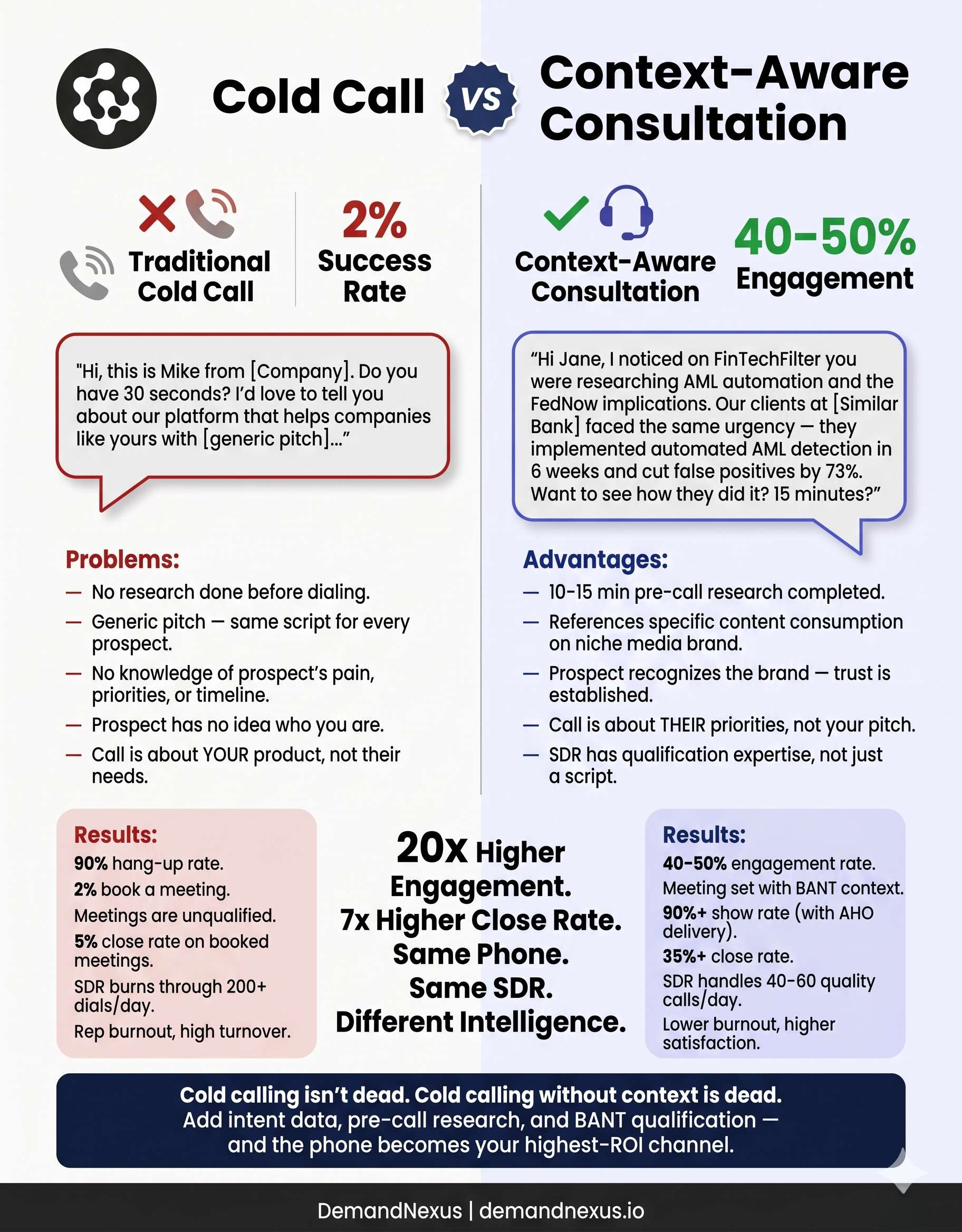
The data tells a clear story. Traditional cold calling averages a 2.3% meeting conversion rate across industries. The average connect rate on cold dials sits between 4% and 6%. These numbers have led many commentators to declare cold calling dead. But the averages mask the variance. Intent-driven cold calling programs that use first-party research signals to prioritize which accounts to call, and that open with context specific to the prospect’s situation, achieve engagement rates between 40% and 50% and meeting conversion rates between 15% and 25%. The difference is not marginal; it is an order of magnitude. For a deeper look at the data, see our cold calling statistics guide at demandnexus.io/cold-calling-statistics/.

Why Most Cold Calling Fails
Most cold calling fails for three reasons that compound on each other. Reason one is targeting: calling accounts that do not fit the ICP or are not in an active buying cycle wastes the majority of dial time before the conversation even starts. Reason two is the opener: leading with a pitch, a permission-based question like ‘do you have 30 seconds,’ or a generic value proposition triggers an automatic rejection response in the prospect. Reason three is qualification: even when a conversation does start, most SDRs are not trained to verify budget, authority, need, and timeline on the call, which means meetings get booked with unqualified prospects who never convert.
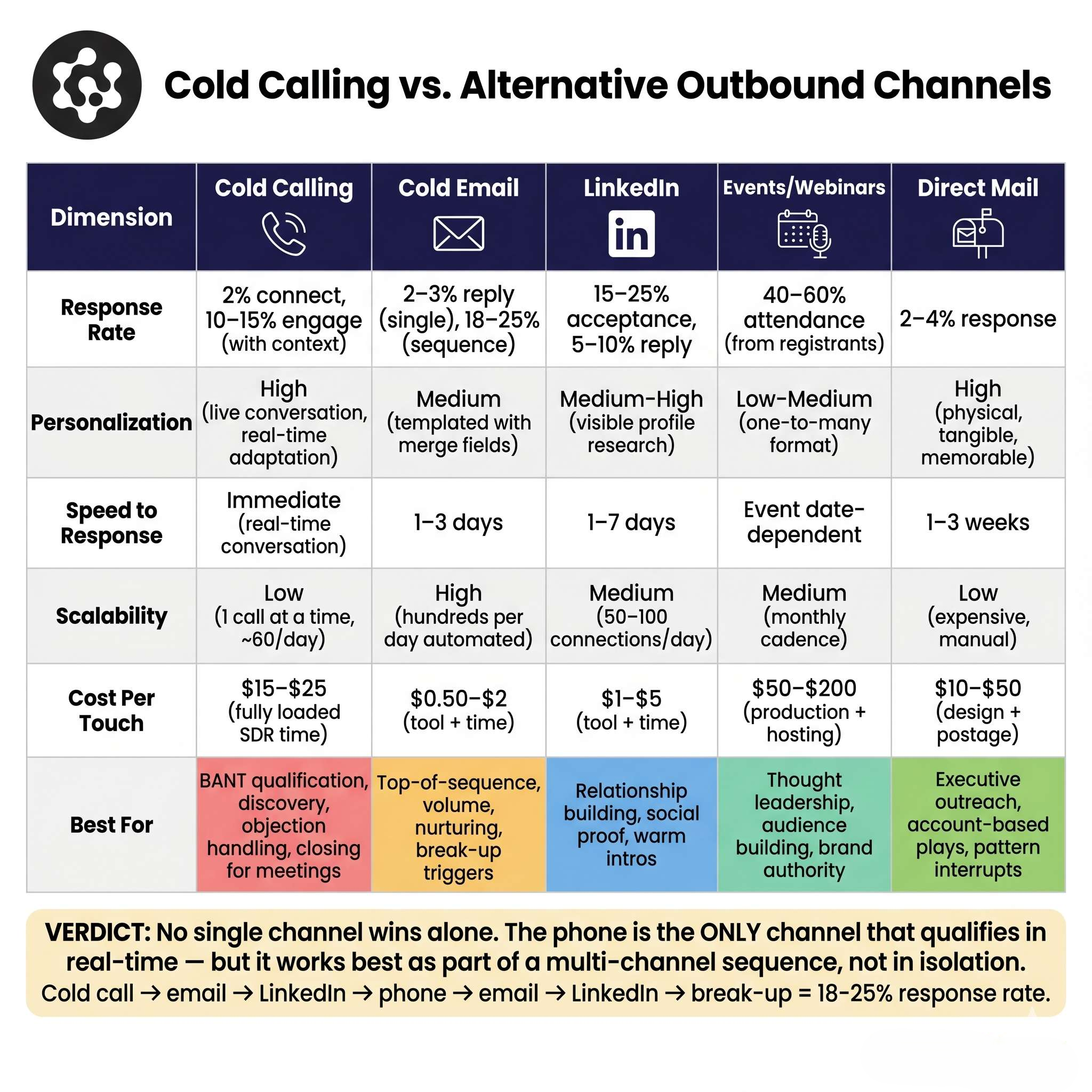
The fix for all three is structural, not motivational. Better targeting through intent data (particularly first-party intent from sources like the DemandNexus media properties: AITechTrend, MarTechTrend, HRTechTrend, FinTechFilter, LegalTechTrend, DevTechTrend) identifies accounts that are actively researching solutions before the first dial. Better openers built on pre-call research replace generic pitches with context that earns the prospect’s attention. Better qualification through the BANT framework ensures that every meeting booked is with a buyer who has confirmed budget, authority, need, and timeline. For proven cold calling techniques that address all three failure points, see demandnexus.io/cold-calling-techniques/.
The Intent-Driven Cold Calling Framework
Intent-driven cold calling replaces the spray-and-pray model with a targeted, research-informed approach. The framework has four stages. Stage one is signal identification: using first-party and third-party intent data to identify accounts showing active research behavior in your category. Stage two is pre-call research: reviewing the prospect’s company, role, recent activity, and likely pain points before picking up the phone. Stage three is the context-aware opener: opening the conversation with a reference to a specific, relevant trigger (a recent hire, a funding round, a technology change, or a content consumption signal) rather than a generic introduction. Stage four is BANT qualification: using the remaining call time to verify whether budget, authority, need, and timeline align for a productive sales meeting.
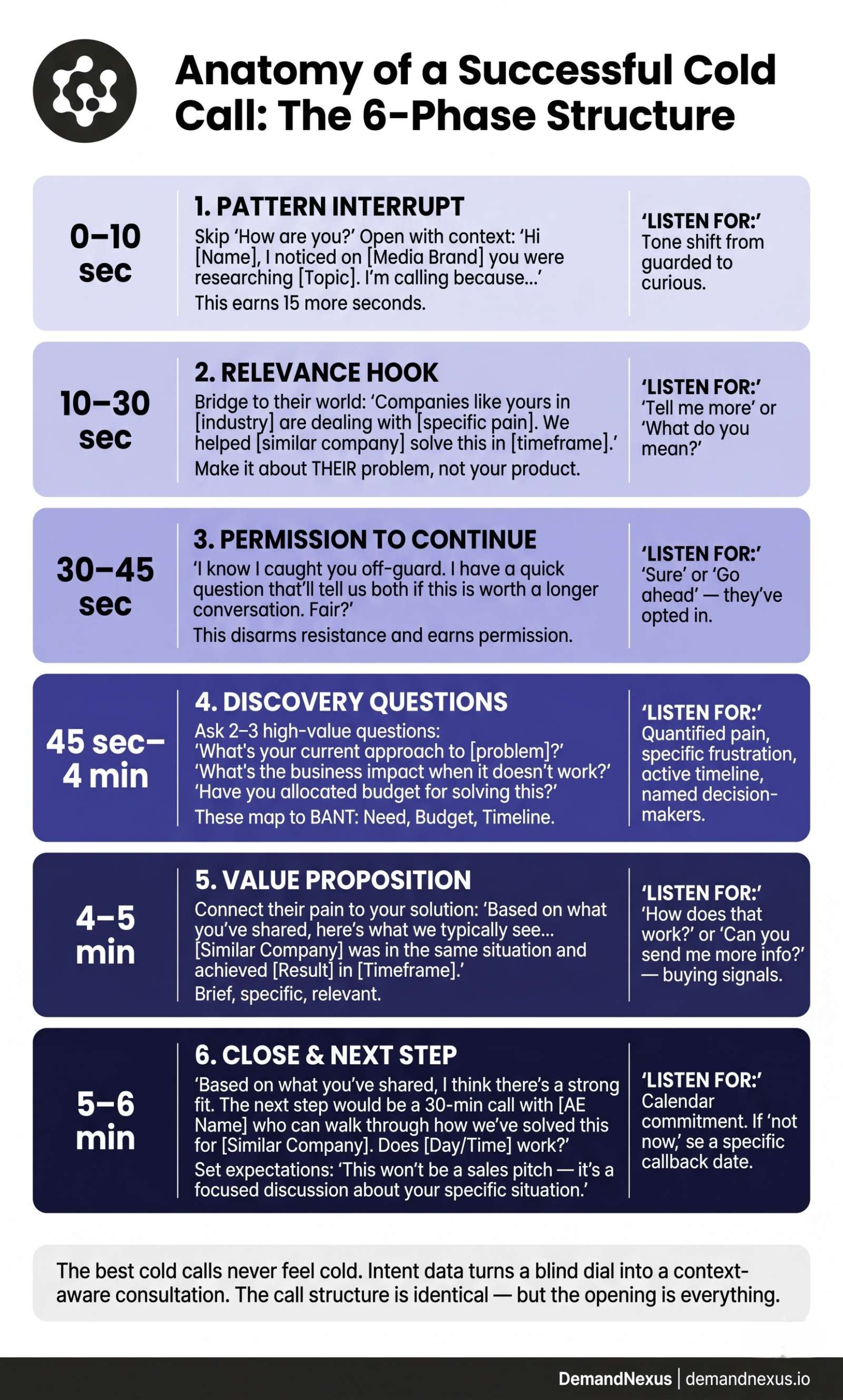
This framework produces fundamentally different results because it changes what the prospect experiences. Instead of an interruption by a stranger reading a script, the prospect receives a call from someone who has done their homework and is asking relevant questions about a real business challenge. The response rate difference (40-50% engagement vs. 2.3% conversion on traditional cold calls) reflects that experiential gap.
Cold Calling Success Rates: What the Data Shows
Understanding cold calling success rates requires separating traditional and intent-driven approaches. Traditional cold calling produces the following benchmarks: average connect rate of 4-6%, average meeting conversion rate of 2.3%, average dials per meeting booked of 200-400, and average cost per meeting of $800 to $1,500 when fully loaded SDR costs are included.
Intent-driven cold calling produces substantially different numbers: engagement rate of 40-50% on connected calls, meeting conversion rate of 15-25%, dials per meeting booked of 30-80, and cost per meeting that is 40-60% lower than the traditional model. The difference comes from calling the right accounts at the right time with the right context. For comprehensive benchmark data, see our cold calling success rates guide at demandnexus.io/cold-calling-success/.
How to Build a Cold Calling Script That Works
A cold calling script is a structured conversation framework, not a word-for-word teleprompter. The best B2B cold calling scripts have five components. Component one is the context-aware opener: a sentence that references something specific about the prospect or their company that demonstrates research and earns the right to continue. Component two is the problem statement: a concise articulation of the business problem your solution addresses, phrased in terms the prospect uses (not your marketing language). Component three is the qualifying questions: open-ended questions that uncover whether the prospect has the problem, how they are currently addressing it, and what would change if they had a better solution.
Component four is the BANT verification: specific questions that confirm budget availability, decision-making authority, documented need, and timeline for evaluation. Component five is the close to next step: a clear, low-friction request for a specific next action (a 20-minute meeting with a specific agenda, not a vague follow-up). For five complete B2B cold calling scripts built on this framework, see demandnexus.io/b2b-cold-calling-scripts/.
Cold Calling and BANT Qualification
BANT qualification is the process of verifying budget, authority, need, and timeline on a live call before booking a sales meeting. In the context of cold calling, BANT verification is what separates a meeting that closes from a meeting that wastes the AE’s time.
The industry data makes this case clearly. Eighty-seven percent of MQLs are rejected by sales teams. The median MQL-to-SQL conversion rate is 13%. These numbers persist because most lead sources, including most cold calling programs, do not verify qualification before passing leads to sales. The DemandNexus Waterfall qualification model requires that every cold-called prospect who agrees to a meeting must first pass live BANT verification. The qualifying SDR then documents the verified information in the Appointment Handover Sheet (AHO), which gives the AE full context before the meeting begins. This is why DemandNexus clients see show rates above 90% and close rates more than 200% higher than on non-qualified leads. For a complete guide to BANT qualification and ICP scoring, see demandnexus.io/bant-qualification-icp-scoring/.
Cold Calling Tools and Technology
The technology stack for B2B cold calling in 2026 includes dialers (parallel dialers like Nooks and Orum for volume, power dialers like Salesloft and Outreach for sequenced cadences), contact data providers (ZoomInfo, Apollo, Cognism for verified direct dials), intent data platforms (Bombora and 6sense for third-party intent, DemandNexus media properties for first-party intent), conversation intelligence (Gong and Chorus for call recording, coaching, and analysis), and CRM integration (Salesforce or HubSpot for activity logging and pipeline tracking). For a detailed breakdown of cold calling software and dialers, see demandnexus.io/cold-calling-software-dialers/.
When to Outsource Cold Calling
Outsourcing cold calling to a pay-for-performance partner makes economic sense in three scenarios. Scenario one is when the fully loaded cost per SDR exceeds the cost per qualified meeting from an outsourced provider (which is common at the $150,000+ fully loaded cost per SDR in major US markets). Scenario two is when the team needs to scale outbound capacity faster than internal hiring allows. Scenario three is when the team lacks the intent data infrastructure to run an intent-driven cold calling program internally.
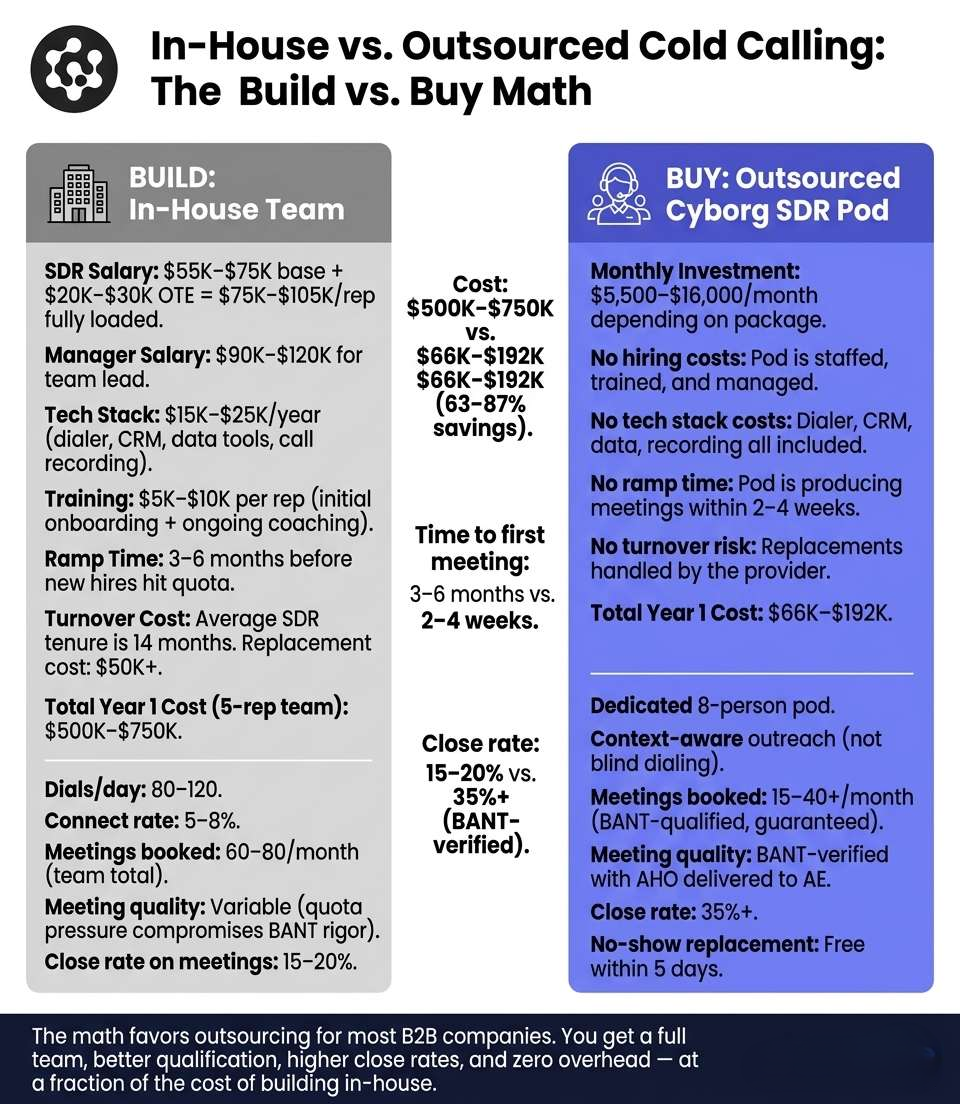
DemandNexus operates cold calling through the Cyborg SDR pod model: AI-powered research and enrichment paired with human-led BANT qualification calls. Clients pay per BANT-verified meeting rather than per dial or per hour, which transfers delivery risk to the provider. For a full comparison of outsourcing models, see demandnexus.io/cold-calling-outsourcing/. For a guide to evaluating B2B cold calling service providers, see demandnexus.io/b2b-cold-calling-services/.
Cold Calling Objection Handling
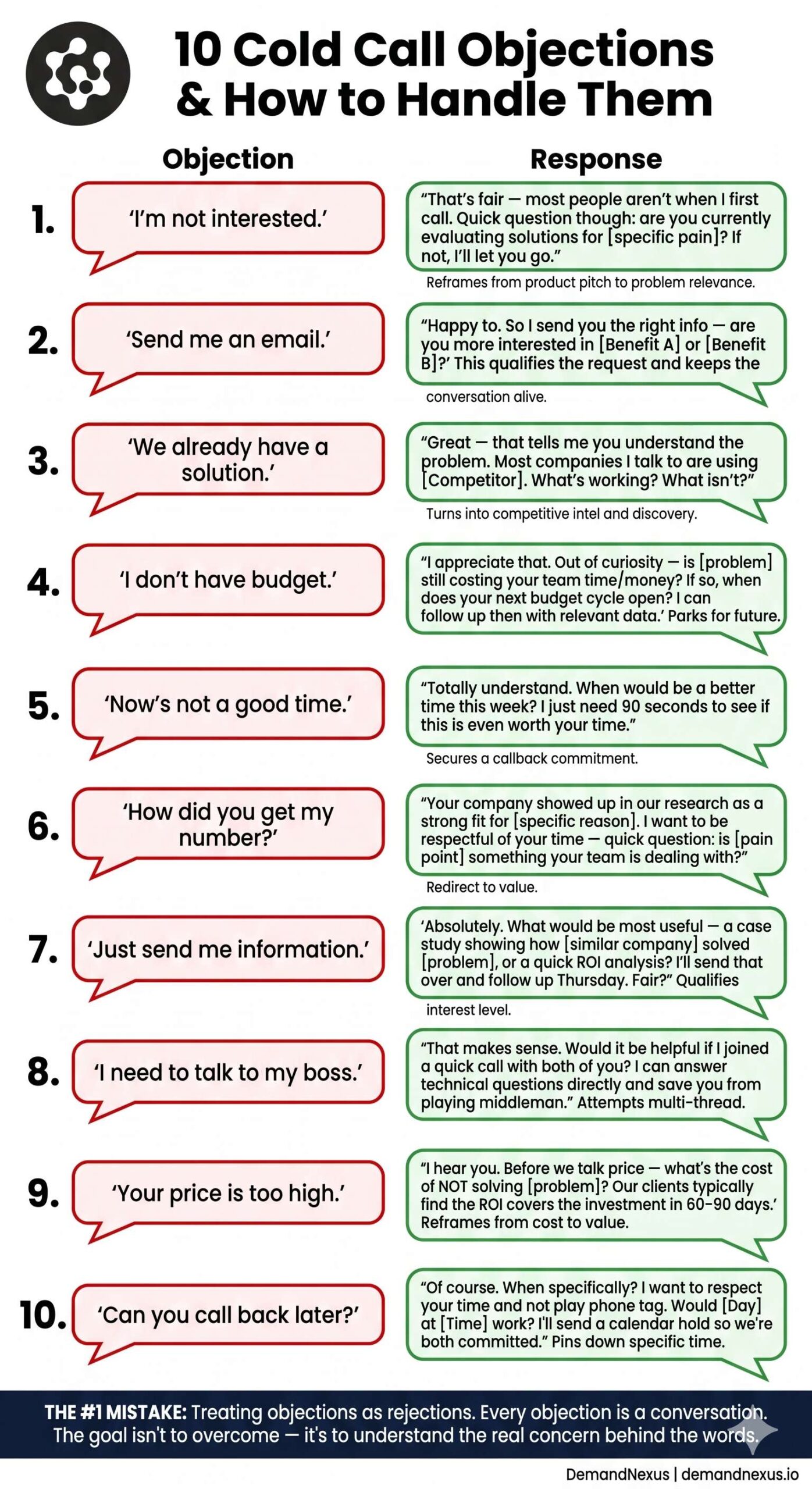
Every cold call will encounter objections. The four most common are: ‘I’m not interested,’ ‘Send me an email,’ ‘We already have a solution,’ and ‘Now is not a good time.’ The mistake most SDRs make is treating objections as rejections. An objection is a request for more relevance, not a final answer.
The response framework for each: For ‘I’m not interested,’ acknowledge and redirect to the specific business problem rather than the product: ‘Completely fair. Before I let you go, can I ask one question? Are your AEs spending more time in discovery calls that go nowhere than in calls that close?’ For ‘Send me an email,’ agree and use the email as a bridge: ‘I will. So I can send something relevant rather than generic, can I ask what your biggest challenge is with [problem area] right now?’ For ‘We already have a solution,’ use it as a qualifying question: ‘Great. How is it performing against your pipeline targets?’ For ‘Not a good time,’ offer a specific callback: ‘Understood. Would Tuesday at 2pm or Thursday at 10am work better for a focused 10-minute conversation?’ For a complete objection handling framework with scripts, see demandnexus.io/cold-call-objection-handling/.
Cold Calling Compliance and Legal Considerations
B2B cold calling in the US, UK, EU, and most major markets is legal but subject to regulations. In the US, the Telephone Consumer Protection Act (TCPA) governs automated and prerecorded calls; B2B calls to business lines are generally exempt from the Do Not Call list but must comply with time-of-day restrictions and caller ID requirements. In the UK, the Privacy and Electronic Communications Regulations (PECR) allow B2B cold calling to corporate subscribers but require compliance with the Corporate Telephone Preference Service (CTPS). In the EU, GDPR applies to the processing of personal data associated with cold calling; legitimate interest is the typical legal basis for B2B outreach but must be documented.
The practical guidance is: maintain a suppression list, honor opt-out requests immediately, do not use autodialed or prerecorded messages without consent, and document the legal basis for processing contact data. For a detailed guide to cold calling regulations by jurisdiction, see demandnexus.io/cold-calling-laws/.
The Fastest Path to More Qualified Meetings
If your cold calling program is producing high dial volume but low meeting quality, the problem is almost always structural: weak targeting, generic openers, or missing BANT verification. The fastest fix is to benchmark your current approach against the intent-driven Waterfall model. Take the qualification diagnostic at demandnexus.io/start-quiz/ or book a pipeline strategy call at demandnexus.io/book-a-call to walk through your current cold calling motion with a specialist.
FAQs
What is the success rate of cold calling in 2026?
Traditional cold calling averages a 2.3% meeting conversion rate. Intent-driven cold calling, which uses first-party research signals and context-aware openers, achieves engagement rates of 40-50% and meeting conversion rates of 15-25%. The difference is driven by targeting, pre-call research, and live BANT qualification.
Is cold calling still effective for B2B sales?
Yes, when executed with intent-driven targeting and BANT qualification. Traditional high-volume, script-dependent cold calling is in decline, but intent-driven programs produce the highest meeting conversion rates the channel has seen. The teams that win at cold calling in 2026 are calling fewer prospects with more context and higher qualification standards.
How many cold calls does it take to book a meeting?
On a traditional spray-and-pray model, 200-400 dials per meeting is typical. On an intent-driven model with pre-call research and first-party signals, 30-80 dials per meeting is achievable. The difference is entirely driven by targeting quality and opener relevance.
What is the best time to make cold calls?
Data consistently shows that Tuesday through Thursday between 10am and 12pm, and between 2pm and 4pm in the prospect's local time zone produce the highest connect rates. Monday mornings and Friday afternoons are the lowest-performing windows. For detailed scheduling data and benchmarks, see our guide at demandnexus.io/best-time-to-cold-call/
Should I outsource cold calling or build an in-house team?
The decision depends on three factors: the fully loaded cost per SDR versus cost per qualified meeting from an outsourced partner, the speed at which you need to scale outbound capacity, and whether you have the intent data infrastructure to support an intent-driven program. Pay-for-performance models like the DemandNexus Cyborg SDR pod transfer delivery risk to the provider and typically produce equivalent or better meeting quality at 40-60% lower cost per meeting.